
 NAAC Accredited — Grade A
CGPA 3.18 (Re-Accredited)
NAAC Accredited — Grade A
CGPA 3.18 (Re-Accredited)
 ISO 9001:2015
Certified Institution
Established 1967
Affiliated to Dibrugarh University
14 Departments
UG & PG Programmes
ISO 9001:2015
Certified Institution
Established 1967
Affiliated to Dibrugarh University
14 Departments
UG & PG Programmes
About Kakojan College
A rural seat of higher education since 1967 — shaping generations of students across East Jorhat with quality, values and opportunity.
Kakojan — The Place
Kakojan is a rural area 16 km east of Jorhat town and 40 km west of Sibsagar town, Assam. The name ‘Kakojan’ comes from a small tributary that originates in the Naga Hills to the south and joins the mighty Brahmaputra in the north. During the administration of the Ahom Kings, the area was famed for producing the choicest rice for the royal family — which is why the Ahom king entitled the Mouza as ‘Chawkhat’, from ‘Chaul Khat’, meaning famous for the finest rice (Chaul, in Assamese).
From a religious standpoint, the area has held great significance since the 16th century. Mahapurush (Saint) Madhavdeva, successor of Mahapurush Sri Srimanta Sankardeva — leader of the Vaishnavite movement in Assam — established the famous ‘Dehekiakhowa Bor Namghar’ in the north-west of the area.
The Ahom Kings constructed the ‘Cheuni Ali’ crossing this area, later converted into NH‑37, the main route of Assam. The famous ‘Lahdoi Gar’ (rampart) built by the Ahom Kings marks the old defences of the Ahom capital ‘Rongpur’, in present-day Sibsagar town to the east. The maidam (grave) of the great national Assamese hero Bir Lachit Borphukon, and the historical ‘Sensuwa Pukhuri’ (tank), also exist in the area. British authorities started tea plantations in the neighbourhood in the 19th century, and companies like Tata Tea Limited and Jayshree Tea Industries Limited still produce tea here today. During India's Freedom Movement, the area was politically conscious, with many freedom fighters actively taking part. Since British administration, Kakojan has been a centre of education — the Govt. M.E. School, started here in 1908, was the first government educational institute between Sibsagar and Jorhat, and over time became the mother institution for many M.V., M.E. and High Schools across East Jorhat.
The College

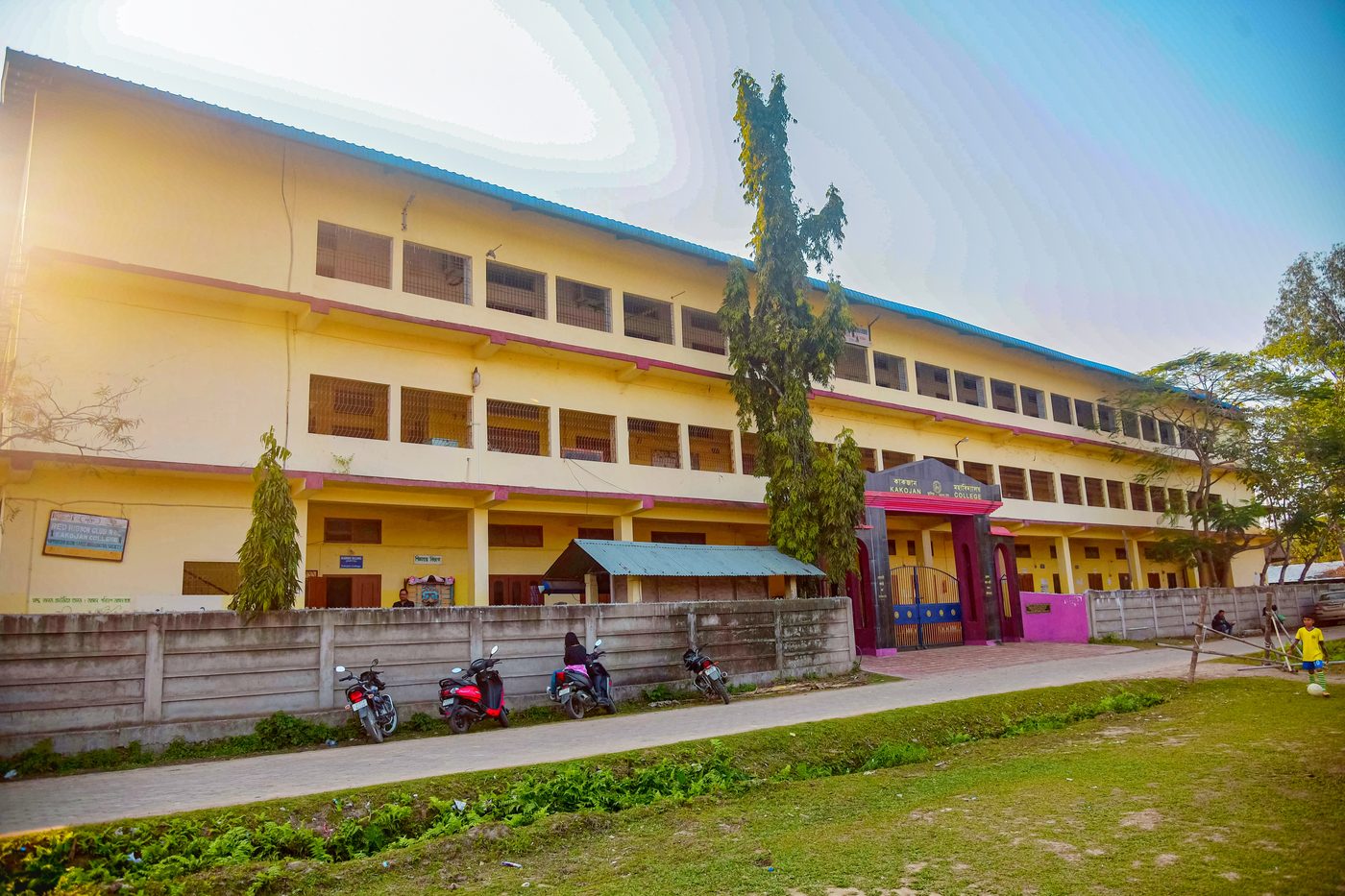
From the 1950s, the people of the Kakojan area felt the need for a college to serve the higher-education needs of an economically backward community. That spontaneous resolve led to the establishment of Kakojan College on 24th July, 1967, built on contributions from educationists and social workers — even beggars and widows offered their mite for it. The college stands in a rural area at the centre of a 12–15 km radius surrounded by M.O.B.C., O.B.C. and general-category families, tea-garden and ex-tea-garden labour, tribal communities, and economically backward and flood-affected households.
At present, the college imparts undergraduate education in Arts, with majors in Assamese, English, History, Education, Political Science, Sociology and Economics. The Science stream began in 1994, offering majors in Physics, Chemistry, Mathematics, Botany and Zoology, with a non-major paper in Statistics.
The college came under the Deficit System of Grant-in-Aid on 01/09/1981 and was registered under UGC Section 2(f) on 12th December, 1998. It was provincialised by the Government of Assam on 1st December, 2005. Over the years it has shown distinguished results in the Faculty of Arts — including 5th position in 2001 and 1st position in 2009 at the H.S. level, alongside first-class results across several degree-level subjects. The college has long run with over a thousand students, thirty-six teachers and thirteen employees, offering generations of service to higher education for rural students from Kakojan and East Jorhat. A healthy academic atmosphere and the personal care of its teachers have made it a natural home of study for students from remote areas — free from the disturbances of city life, with ongoing plans for new buildings, a library and green, flower-filled gardens across the campus.
Establishment & Accreditation
Vision & Mission
Our Vision
The vision of the college is the all-round development of human resources through quality education, under the guidance of its Affiliating University, the UGC, NAAC and the Govt. of Assam. The institution upholds the highest standards of instruction in Arts and Science with vocational courses. Alongside academic excellence, it emphasizes democracy, co-operation and cultural sensitivity, so students may best serve society, the nation and the world — and cherishes extending education to learners deprived of formal higher education, by age or economic background, through an Open Distance Learning (ODL) system.
Our Mission
- Imparting quality education of national standard and imbibing skills for solving real-life problems.
- Inculcating a global perspective in attitude.
- Creating leadership qualities with futuristic vision.
- Fostering the spirit of entrepreneurship and realization of societal responsibilities.
- Cultivating adoption of ethics, morality and healthy practices in academic and professional life.
- Inculcating the spirit of social development through the study of language and culture.
- Instilling the habit of continual learning.
- Encouraging and supporting creative and research temperament.
- Establishing and promoting linkages with institutions and organizations at national and international level.
- Introducing job-oriented and vocational courses for professional and academic development.
- Organizing community development programmes for the socio-economic development of the neighbourhood.
Our Special Features
The college, being an institution of Higher Education, is marching towards ‘Quality Education’.
All courses of both Arts and Science streams are affiliated to Dibrugarh University and recognised by the UGC.
A proper academic environment for the effective development of human resources.
Regularity and punctuality in teaching-learning. Experienced, highly qualified faculty guide students in their future studies, placement and practical knowledge — shaping smart, energetic, dynamic citizens.
Traditional teaching is supplemented with Audio-visual Aids, Group Discussion, Individual Guidance, Seminars, Workshops and Field Work.
Collaboration with Other Institutions & Organizations
Faculty exchange and community development collaboration with the School of Social Sciences, Assam Kaziranga University, Jorhat.
The “Organic Model Garden & Production Unit” in the campus’s extended area (Sector-B), in collaboration with NEADS (a local NGO) and support from Fertile Ground (NGO), Canada.
A short-term Entrepreneurship Development Course with the Indian Institute of Entrepreneurship (IIE), Guwahati, Assam.